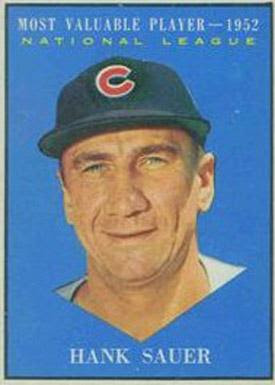
You will find a vast resource of vintage Cubs baseball cards, feel free to view pictures of my collection, read commentary on the players, teams, sets and sub-sets.
Although card backs are rarely mentioned, the back can be highly fascinating. By offering facts that people might not be aware of, they complete a picture. A treasure trove of interesting, amusing, and practical information on baseball trivia. Children and adults both enjoyed the cartoons on the back. Some of them featured tests on baseball's history or regulations.
In the upper left corner of the back, inside a baseball with the phrase "Topps," is the card number.
A three-pane cartoon was featured in addition to the athlete's bio and statistics, as well as a brief description of the player.
1961 Topps grew to a new high of 587 cards, of which 32 are Cubs players.
Card Dimensions
The standard-sized cards are the following dimensions: 2-1/2" by 3-1/2"
Basic Features
In 1961, Topps increased its collection to 587 cards and reverted to a vertical layout. Each player photo in this series features their name and team in a small box at the bottom. This year marked the debut of specialized cards, including the "League Leaders" (41-50), and it was also when the Topps Rookie All-Star awards were introduced. Even in great condition, the backs of the cards can be hard to read due to the black and army green printing on dark card stock. This set includes the player's season-by-season and career stats, along with some cool cartoons.
Two insert sets are included in 1961 Topps Baseball. The majority of the stamps were offered in either a green or a brown tint and were printed in panels of two. Series 1 packets also included Magic Rub-Offs, which are essentially temporary tattoos. There are 36 cards overall, with one player and one pennant accessible to each club.
The key 1961 Topps Rookie Cards are Hall-of-Famers #35 Ron Santo, #141 Billy Williams
Always ensure that you obtain a professional grading service from a reputable company to avoid acquiring a counterfeit piece of history. The long-term value of graded cards is significantly higher.